






We discover pathways to new systems that successfully integrate human and ecological communities, fostering places where people and nature thrive.
We have a unique approach to achieving this goal. Drawing diverse, talented individuals across disciplinary and cultural boundaries, we assemble and support teams that discover viable paths to socio-ecological regeneration. These remarkable teams, which we call Collaborative Earth Labs, bring together leading-edge expertise and deep local understanding. Each Lab focuses on a specific system and discovers solutions suited to its distinctive context; scaling is achieved through adaptation and diversification, not homogenization or hegemony. At present, for instance, we are working with Native American tribes to restore their grasslands and bison herds, with communities along the Ganges to develop green infrastructure to treat water pollution, and with landowners to replenish the diverse forests that once lined waterways in the American Southeast. Always, though, our work helps communities engage in deeper and more enriching relationships with the landscapes they steward.
A large, diverse, and growing network of individuals are eager to bring their special expertise and talents to work that supports socio-ecological regeneration.
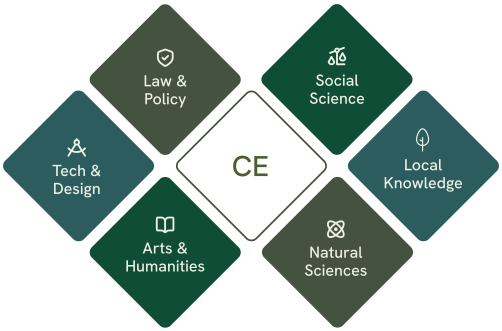
The CE Open-Knowledge Network includes many figures at the leading edge of specific disciplines, as well as individuals with profound local knowledge of specific socio-ecological systems. Sometimes, these two sorts of expertise reside in a single person. Indeed, a number of our Collaborative Lab Leaders—a role we’ll describe in more detail below—are such hybrid experts, bringing together advanced understanding in a certain field of inquiry and deep familiarity with a particular place.
We use the term open-knowledge to extend the concepts of open-source, which is very familiar in technological circles, and open-science, which is now common in certain scientific disciplines. In adopting the term, we intend to emphasize two points: First, important data, discoveries, and technologies generated by our work must be held in the public trust or delivered to the public domain; they must not be guarded to benefit only a few. Second, the network strives to lower barriers to effective collaboration between disciplines, institutions, and cultures.
From calling for proposals to realizing plans, our process activates a diverse network united by a common goal.
Our process for convening Collaborative Earth Labs begins when the CE Organizing Team issues a call for proposals from the Open-Knowledge Network. In a proposal, a prospective CE Lab Leader answers three important questions. First, what is the need or challenge that stands in the way of socio-ecological regeneration? Second, which skills and expertise will be required to address the challenge? And third, what will be the new CE Lab’s theory of change? In other words, if the lab meets its goal, how will the deliverables catalyze socio-ecological regeneration?
The Organizing Team then turns to members of the open-knowledge network with appropriate expertise, asking them to help select proposals for inclusion in the next cohort of CE Labs. Once selected proposals have been revised and refined in response to reviewer input, they are announced and circulated to the entire network. At this point, individuals in the network step forward to volunteer the insights and skills required by the newly proposed labs. New CE Lab Leaders and the Organizing Team work together to assemble coherent and promising constellations of expertise. And finally, the new cohort of CE Labs is launched.
CE Lab Facilitators help teams to plan their work and keep it moving forward. Vitally, Lab Facilitators also return to the open-knowledge network to fill new needs as they become apparent.
Each Lab works toward three different kinds of outcomes, which are not mutually exclusive.
First, they might simply deliver the products of their work—such as a powerful digital tool, a visionary plan, or an actionable piece of research—into the hands of those best-positioned to use it in pursuit of socio-ecological regeneration.
Second, when CE is uniquely positioned to realize plans charted by a CE Lab, the Lab will transition into a Collaborative Earth Project, which CE moves forward, in close collaboration with local partners, to co-create a thriving socio-ecological system.
Third, a CE Lab or CE Project may launch into a fully or partially independent organization. In this scenario, the CE Organizing Team and Lab Facilitators support the crucial process of selecting and then pursuing the appropriate financing model. There are multiple sources for funding ongoing work and growth: philanthropic organizations, from small family offices to the largest foundations; various levels of government; traditional business investment funds; or venture capital. The considerations that favor one path versus another are complex, and finding the right fit is absolutely critical to translating a Lab’s work into maximal beneficial impact.
To contend with the structure of the challenge, we are developing an adaptive process, not a single product
Globally, socio-ecological crises arise from distributed and varied situations in which people are powerfully incentivized to degrade ecosystems instead of regenerating them. Therefore, to address this challenge at scale, we must create not a single innovative product, but rather a process to devise or recognize regenerative strategies adapted to specific systems.
While the CE Labs emerging from this process are diverse, they do tend to share certain themes born of their common origin. They tend to be highly interdisciplinary as well as multi-cultural, bringing together the specific skillsets needed to solve a complex problem with the local knowledge needed to assess and ultimately achieve local cultural and ecological suitability. They share a commitment to producing truly actionable research, with a theory of change that is in place from the start yet may evolve as the team learns.
Our methodological watchwords characterize how Collaborative Earth works differently from most organizations.
Collaborative Earth Labs are emergent in the sense of the word as it is used in complexity science: They assemble from varied parts to create an integral whole with distinctive capacities of its own; and the intelligence that creates them resides not in a single strategist directing things from the top, but in the distributed collective that comes together to form the new whole.
Wayfinding, a word often used in reference to various cultures’ sophisticated practices of navigation, also describes the work that unfolds within CE Labs, which integrates diverse categories of information to discover orientation and set direction. In many CE Labs, deeply rooted local knowledge is an essential element in the co-creative process, which may also call on various scientific disciplines and leading-edge technologies.
In all of the pathways that CE Labs follow to impact—delivering a useful creation, spinning out into sustainable independence, or collaborating with a community as a CE Project—our work becomes emergent in the more colloquial sense of something pushing its way into reality. And ultimately, the ongoing work of CE Projects, too, entails wayfinding, which is itself emergent: As we pursue socio-ecological regeneration in close partnership with communities, we are not always following well-laid paths that extend before us. Sometimes, we are co-creating novel systems, building the spiral staircase as we rise.
SES theory acknowledges that plans for regeneration must incorporate economic, cultural, and ecological processes.
A concept we adopt from economist Elinor Ostrom and her collaborators, Social-Ecological Systems (SES) encompass physical processes like rainfall or wind, biological processes like the growth of grass or trees, and social processes like education or economic activity. SES analysis recognizes that each kind of process depends on the others: A community with a culture and economy that favor stewardship of trees will foster ecological restoration of a forest which will in turn alter local patterns of rainfall.
The emphasis that SES analysis places on the integration of social and ecological elements is especially important now for two reasons. First, humanity has become an overwhelming force in every ecological system on Earth, and therefore we must acknowledge and embrace our role as our planet's gardeners. At the same time, human communities are suffering in many ways from their broken relationship with the more-than-human systems that sustain them. SES explicitly knits back together what we should not think of as separate.
Our degradation of ecosystems is too far gone to think merely of conservation. We must not only halt the loss of intact ecosystems, the alteration of planetary chemistry, and the shift in climate—we must reverse these trends. Fortunately, the science and technology of ecological restoration and stewardship integrate centuries of practice with many recent advances, offering a powerful body of applied knowledge. Our understanding of the economic and cultural forces that drive people to degrade or to restore the ecological systems that sustain them has also advanced enormously. As a result, we are increasingly capable of reconfiguring our own local systems in favor of regenerative cycles.
Speaking more specifically and practically, what do we really mean by socio-ecological regeneration? In our current CE Projects, we are primarily focused on seven goals, which we believe to be not only mutually compatible but strongly synergistic:
1. local social and ecological resilience to climate change;
2. contribution to national and global goals of reduced greenhouse gas emissions;
3. recovery of large and continuous tracts hosting biodiversity commensurate with old-growth;
4. local food sovereignty and security;
5. increased local revenues through access to markets in ecological benefits and high-value products tied to place-specific narratives;
6. increased local socio-economic equity and environmental justice;
7. protection and recovery of local cultural traditions of ecological stewardship.
Climate change appears right at the top of this list because it is an immense socio-ecological challenge. While fossil-fuel emissions are one product of our political economies, climate change is inseparable from the broader process of ecological degradation. The biosphere sequesters ~50% of our greenhouse gas emissions, and without this vital buffer, we would already be well beyond IPCC's worst case 2050 prediction. Moreover, degraded ecosystems release greenhouse gases, and accelerating feedbacks are now emerging. Finally, ecosystems determine how we experience climate change: Climate-driven food insecurity, water stress, heat events, and rising sea levels are mitigated by intact ecosystems and exacerbated by their loss.