





Effective reforestation depends on practitioners having timely access to proven best practices, contextual ecological knowledge, and region-specific guidance. While a large body of high-quality restoration literature exists, it is often fragmented across multitudes of documents that are highly technical and difficult to navigate, creating a significant barrier to real-world decision-making.
AI offers the promise of synthesizing large knowledge bases into accessible answers. However, applying AI to ecological decision support introduces epistemic risks: incomplete or biased knowledge bases, loss of context during summarization, over-confident or misleading outputs, and evaluation metrics that prioritize surface-level relevance over decision quality.
.png)
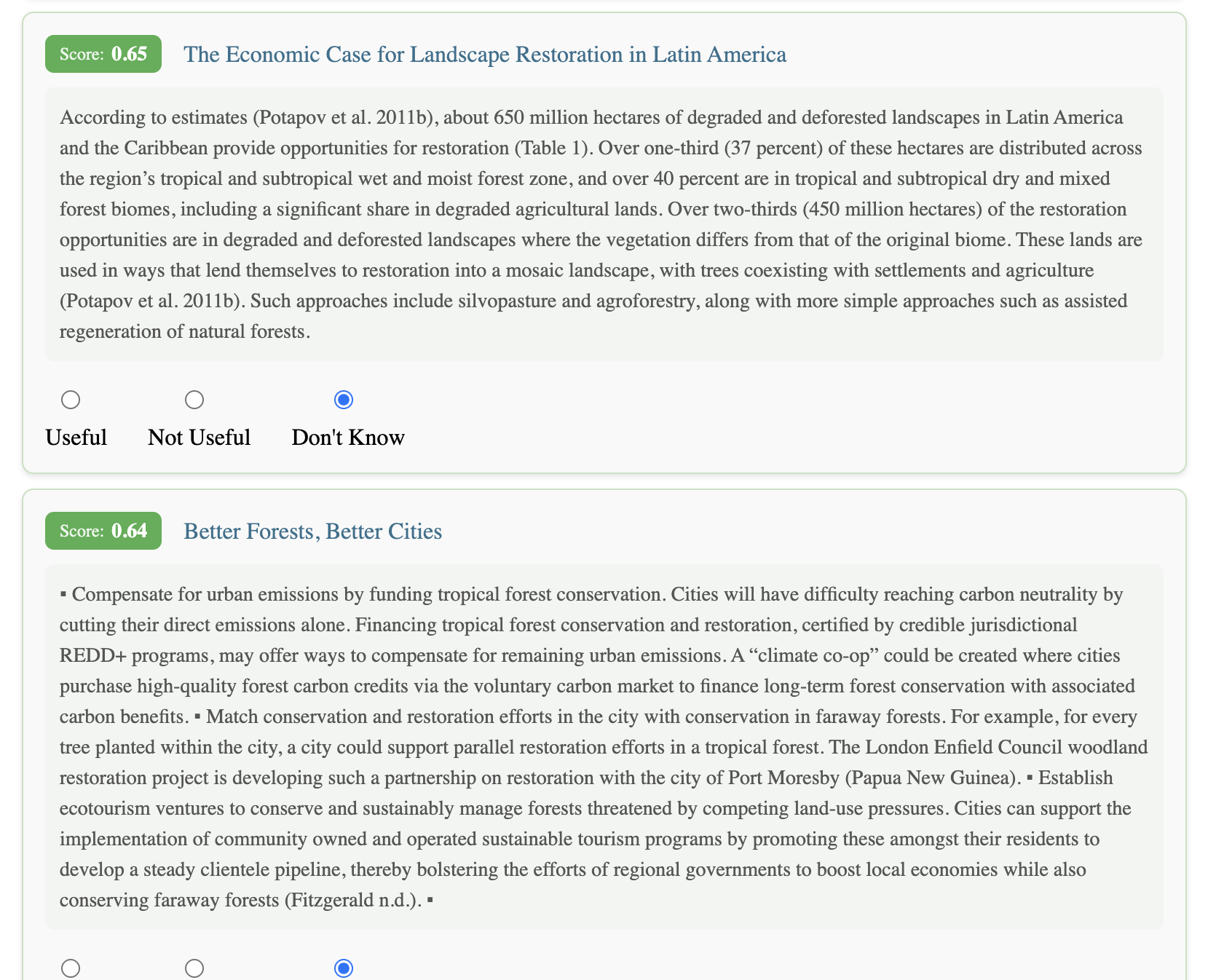
Example of use with a current state of the tool after adding in a few more in scope sources from WRI.
Aicacia addresses both the access challenge and the epistemic risk challenge. Rather than treating AI outputs as authoritative, Aicacia is designed to support human judgment by emphasizing evidence provenance, uncertainty, and failure awareness.
Aicacia is a domain-specific search and question-answering system built on curated reforestation literature and expert-vetted sources. Its core goals are to:
1. Catalog and organize reforestation knowledge in a transparent, structured, and user-friendly way, preserving links to original sources and context.
2. Enable evidence-grounded search and Q&A, helping practitioners surface information relevant to specific geographies, ecosystems, and restoration interventions.
While off-the-shelf language models can support generic searches, they fall short in ecological domains where nuance, uncertainty, and local context matter. Aicacia develops and evaluates domain-specific models and datasets, trained on expert-vetted, curated sources, with an emphasis on interpretability and responsible use.
Embedded in our work on this project is research into epistemic risk in AI-assisted decision-making. We study where common evaluation metrics (such as retrieval relevance or RAG-based scores) fail to capture real-world usefulness, and we develop qualitative failure taxonomies to better understand how AI systems can mislead, oversimplify, or omit critical ecological considerations.
Wherever possible, Aicacia’s datasets, models, and research findings are released openly, with the goal of contributing not just a tool, but a framework for building safer, more reliable AI systems for environmental decision support.
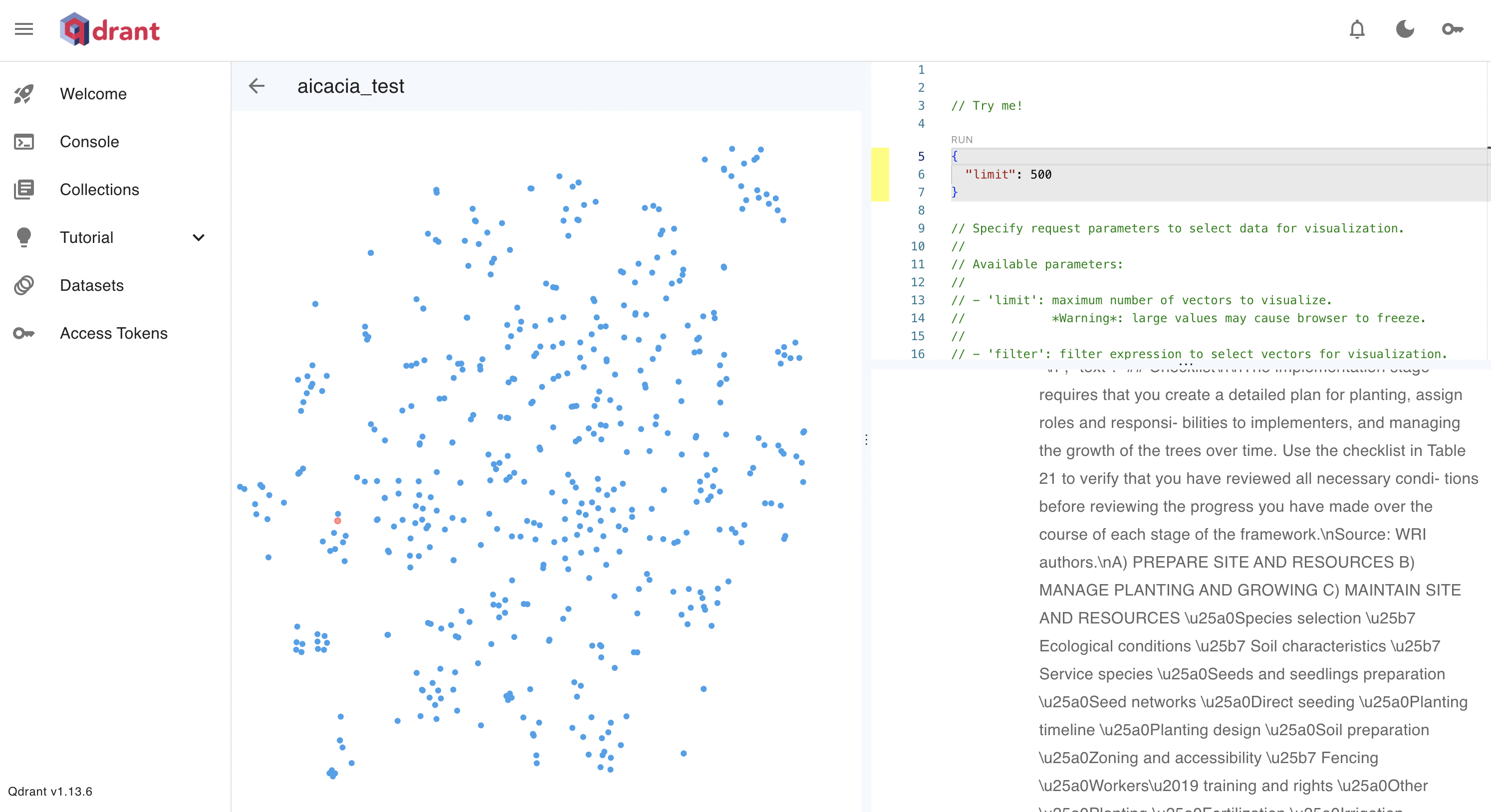
Visualization of an early iteration of the vector database (essentially a cloud of points representing the chunks of all the documents)
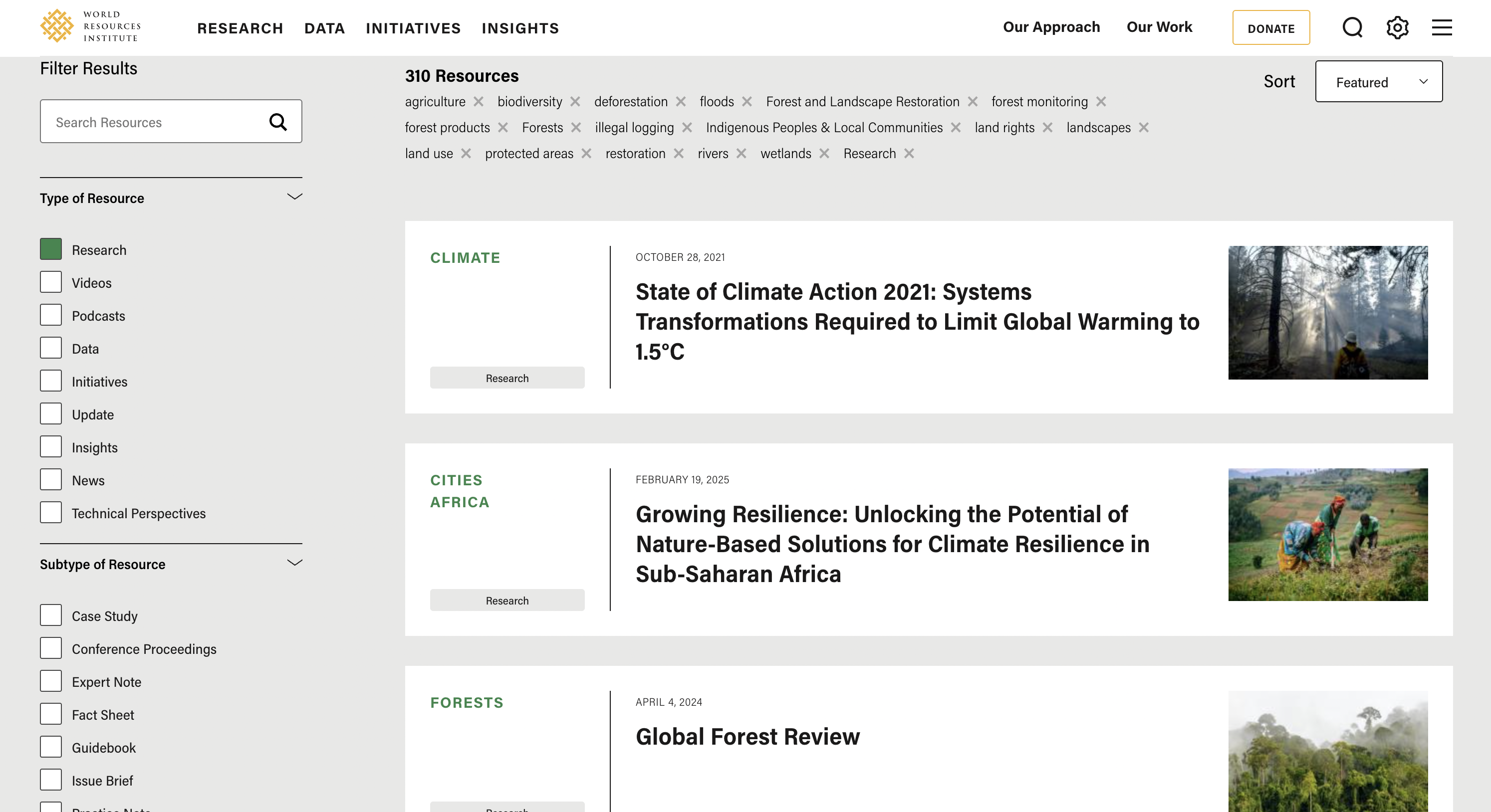
Example of some of the sources the lab pulled from WRI
-
Software Engineer, Slack
Lab Co-Leader
Software Engineer, Slack
Sherin Thomas is a software professional with over 12 years of experience in big data, data visualization, and machine learning. She has a strong interest in climate science problems, and has assisted NASA's SpaceML project in building software to process petabytes of satellite imagery to detect phenomena like hurricanes and forest fires. Sherin has extensive experience as a software engineer for major tech companies including Netflix, Lyft, and Slack, and is the Lab Leader for CE’s Aicacia Lab.
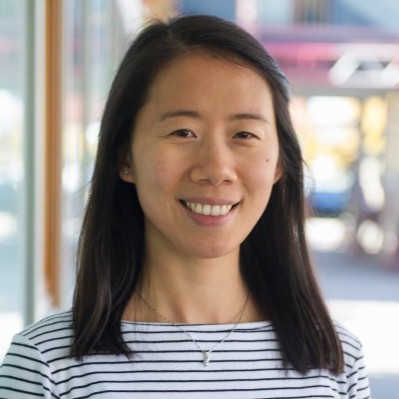
Computational Chemistry, AbbVie
Lab Co-Leader
Computational Chemistry, AbbVie
Dr. Michelle Liu is a chemical engineer with expertise in computational chemistry of crystalline and microporous materials, as well as a naturalist guide and lab leader for CE. She has worked on applications in catalysis, gas storage for carbon capture, and energy storage, and works to use computational modeling for societally relevant problems in chemical, environmental, and health sciences. She holds a PhD in Chemical Engineering from UC Berkeley.

Web Development, Freelance Professional
Lab Member
Web Development, Freelance Professional
Benji Friedman is a web developer focused on front-end engineering and creating clean, modern, and responsive websites that are fast, accessible, and thoughtfully designed. He collaborates with a variery of clients to build intuitive, flexible, and visually crafted sites, and draws on his background in digital and physical art.
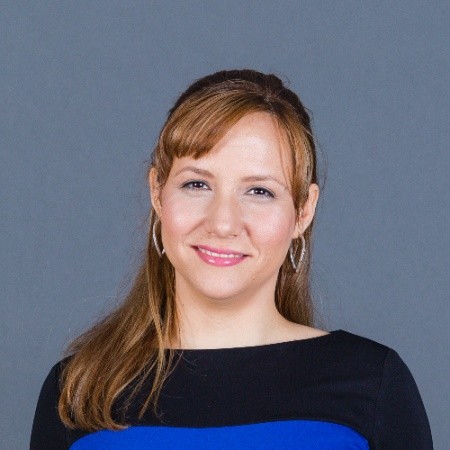
Computer Science, AlayaCare
Lab Member
Computer Science, AlayaCare
Evelin Fonseca is a computer scientist with a foundation in mathematics and programming who is dedicated to leveraging the power of machine learning for positive global impact. As a versatile full-stack AI Developer, she brings hands-on experience in both Artificial Intelligence and the development of web and desktop applications.
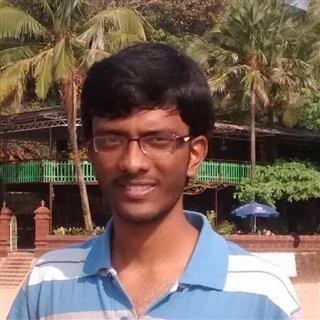
Software Engineering, Coefficient
Lab Member
Software Engineering, Coefficient
Guru Prakash is a Senior Software Engineer at Coefficient with expertise in data engineering and large language models. He has worked in a variety of software development roles with companies like Cloudera and Amazon, and he is a part of CE’s Aicacia Lab.

Independent developer
Lab Member
Independent developer
Krysia Llull is a software developer with experience in machine learning, UI, and frontend development. She brings a particular expertise with data pipeline development and SQL. She holds a professional masters in Machine Learning from the Université de Montréal through Mila, the Quebec Artificial Intelligence Institute.

Computational Neuroscience, UKE
Lab Member
Computational Neuroscience, UKE
Dr. Simone Blanco Malerba is a physicist, engineer, and postdoc researcher at University Medical Center Hamburg-Eppendorf (UKE) working in computational neuroscience. His research has applied modeling and machine learning skills to other complex systems, including networks, power grids, and CE’s Aicacia Lab. He holds a PhD in Physics from the Ecole Normale Supérieure.

Computer Science, movingimage
Lab Member
Computer Science, movingimage
Vladislav Gerasimov is a software engineer with expertise in numerous programming languages including Java, Kotlin, and Python. He works as a Senior Back End Developer at movingimage and volunteers as a software engineer at multiple environmental non-profits.