





Forest ecosystems naturally go through cycles of disturbance and regrowth. This can be caused by biotic factors like insects or disease outbreaks, or abiotic factors like wildfire, landslides, or harvest. If disturbances become too frequent or severe, they may trigger ecological transformation, resulting in drastic and enduring changes. Understanding the relationship between disturbance and regrowth is thus an important challenge in basic ecology as well as forest management.
This dynamic is a difficult one to unpack, though, as ecosystems are subject to a huge number of factors that influence their susceptibility and resilience to disturbance. On top of this, the multiple effects of global climate change along with the ecosystem memory of long-established forests all add complication. The Global Forests Lab used multiple large datasets, along with machine learning models, to grapple with this seemingly intractable problem.
Specifically, the Global Forest team used the NASA Landsat 5, 7, and 8 time-series data—roughly weekly snapshots of the planet's surface that go back nearly twenty years— to map where major forest disturbances occurred by using an algorithm that looked for sudden color changes from one snapshot to another. They then used data from the GEDI tool aboard the International Space Station to estimate biomass in post-disturbance plots in order to establish a set of regeneration trajectories. Finally, these trajectories were linked with climate and topology data derived from numerous sources like the European Space Agency’s Copernicus mission. All this data was used to build a machine learning model that relates climate and topography to the regeneration of biomass.
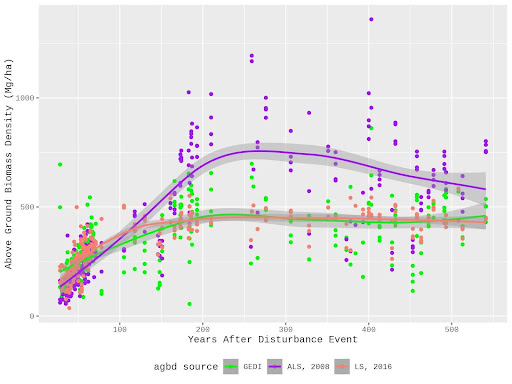
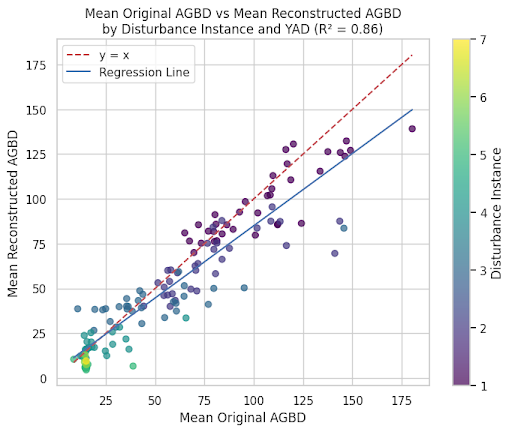
The team has tested their model on a specific plot in the HJ Andrews Experimental Forest in the Blue Mountains of Western Oregon. This forest has been extensively studied, and has a deep dataset of field measurements against which the global model was tested. In this initial test, they found that significant repeated disturbance can have a cumulative and ultimately overwhelming effect on rates of forest regrowth. Because of these accumulating legacy effects, common management practices such as repeated economic harvests are depleting the carbon sequestration capacity of potentially large carbon sinks.
The approach the team devised is not difficult to generalize. In theory, it can be applied to almost any forested and disturbed location on earth, because both Landsat and GEDI are datasets of nearly global extent. The team aims to ultimately provide a tool that will be of use for a variety of users, including foresters, carbon project developers, and restoration ecologists.
-
Remote Sensing, Ecology, University of Hawaii
Lab Leader
Remote Sensing, Ecology, University of Hawaii
Aron Boettcher is a Co-Founder of Wuuii, PhD Student at the University of Hawaii, and is the Lab Leader for CE’s Global Forest Lab. Aron focuses on issues related to water use, efficiency, and global forestry with a particular interest in human interactions with urban and suburban spaces. His work with Wuuii also helps communities and ecosystems adapt to wildfires and climate change threats. He uses machine learning, spatial analytics, statistics, and programming in his research.

Software Engineering and Ecology, Spectrum Health
Lab Member
Software Engineering and Ecology, Spectrum Health
Andre Otte is a backend software developer with experience working on enterprise and open source software. While the majority of his professional experience is with SQL and the .NET stack, he works with a wide variety of tools and technologies. Before his career in software development, Andre worked as an ecologist at a nonprofit in Grand Rapids. He is currently part of the Global Forest Lab as a computational resources manager.
Soil Science and Forest Carbon Dynamics, Oregon State University
Lab Member
Soil Science and Forest Carbon Dynamics, Oregon State University
Dr. Hayley Peter-Contesse is a soil biochemist who uses GIS, remote sensing, and machine learning to study and map ecosystem carbon cycling in temperate and tropical systems. Her work has focused on carbon dynamics in western forests, wildfire impacts, and more. She currently works as a postdoc researcher at Oregon State University and University of Hawaii at Manoa, and earned her PhD in Soil Science from Oregon State.